
You Can't Improve What You Can't See: Why Every Local Business Needs a Marketing Dashboard
Building a Looker Studio Dashboard for Flow Spa.
Most small business owners are running their marketing blind.
Not because they don't care. Not because they're not smart. Because the data is scattered across four different platforms, none of them talking to each other, and nobody has time to log into all of them every week and piece together what's actually working.
That changes with a marketing dashboard. And it's more accessible than you think.
What we built — and why it matters
Recently I went through the process of building a Looker Studio dashboard for Flow Spa, a wellness and recovery spa in Peterborough, Ontario. Flow Spa runs Google Ads, Meta Ads, and tracks website behaviour through two separate Google Analytics properties — one for their Squarespace website, one for their Float Helm booking system.
Before the dashboard, reviewing marketing performance meant opening Google Ads, then Meta Ads Manager, then GA4, then Float Helm's analytics — four separate logins, four separate date pickers, four separate mental models to reconcile into one picture. The weekly review took longer than it needed to, and cross-channel insights were easy to miss.
After the dashboard: one URL, one date range control, four pages. Change the date once and every number updates together.
That's the whole point.
What the dashboard actually shows
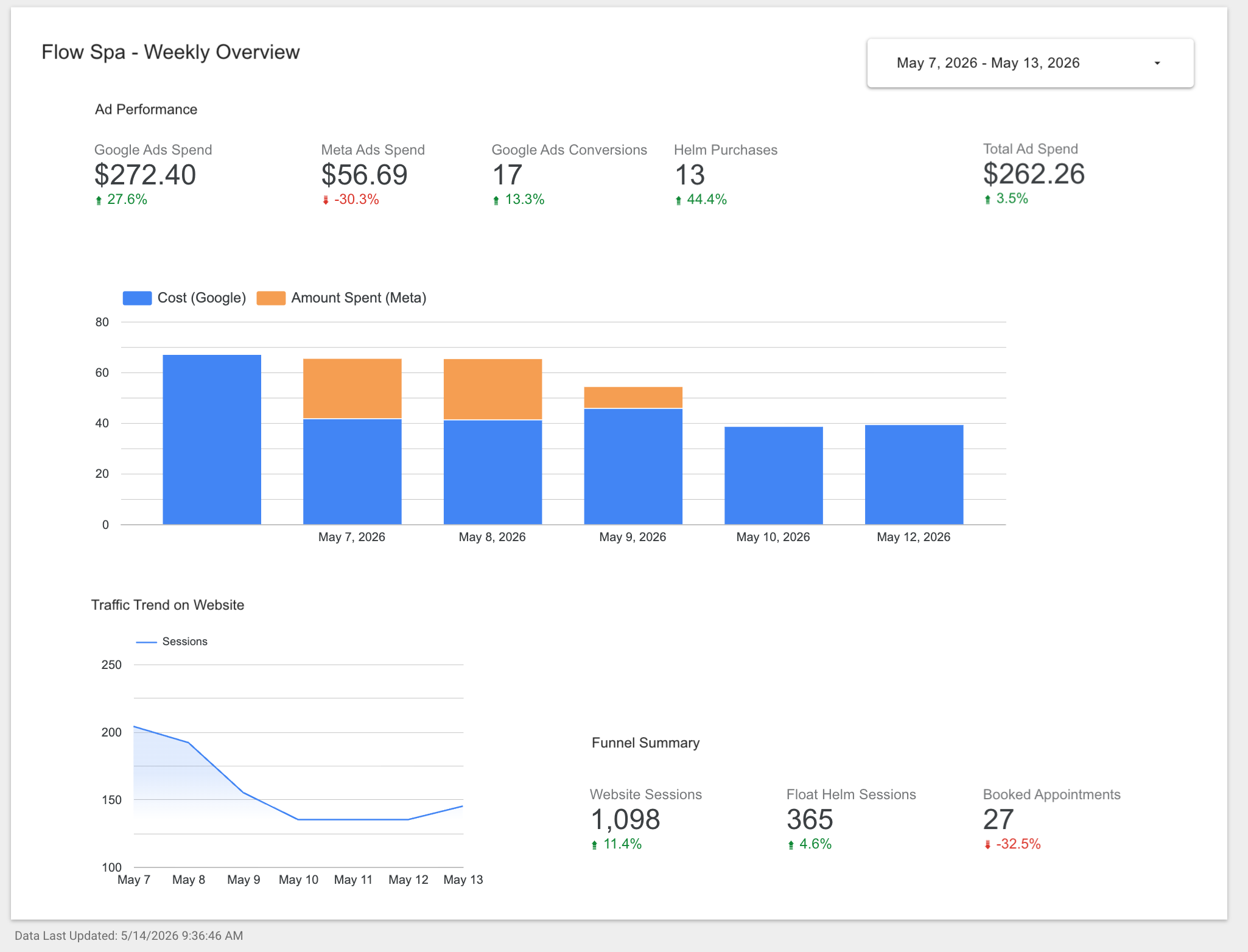
The Flow Spa dashboard has four pages, each answering a different question.
Page 1 — Weekly overview. Total ad spend across both platforms ($327 last week), conversions, purchases, and a stacked daily bar chart showing how Google and Meta spend was split each day. One glance tells you what you spent and whether it was balanced or weighted toward one channel.
Page 2 — Google Ads. Campaign-level spend, clicks, conversions, CPA, and CTR — with week-over-week comparisons on every number. The campaign table alone surfaced something immediately useful: the Float campaign was delivering a $12.64 CPA at 9% CTR while the top-spend campaign was at $22.08 CPA and 7.2% CTR. That's a budget reallocation conversation waiting to happen — and it only showed up because the data was in one place.
Page 3 — Meta Ads. Spend, reach, CPM, link clicks, purchases, and ROAS by campaign. Plus a platform breakdown showing Facebook vs. Instagram vs. other placements. The Mothers Day Conversions campaign showed a 7.13 ROAS last week — that's a strong return that deserves to be seen clearly, not buried three clicks deep in Ads Manager.
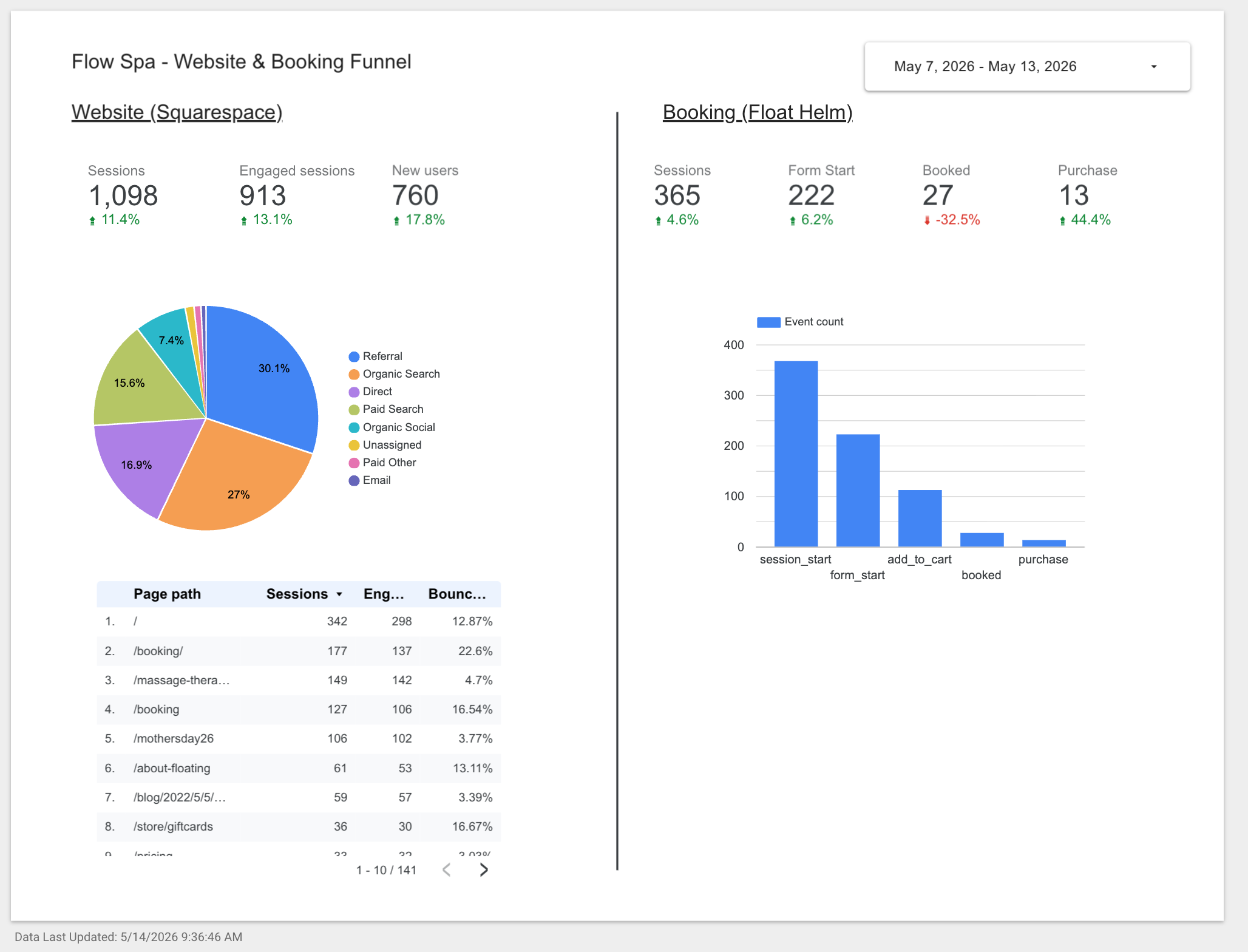
Page 4 — Website and booking funnel. This is the most valuable page. It splits into two panels: the Squarespace website on the left, the Float Helm booking system on the right. Together they show the full customer journey from first website visit to confirmed booking.
Last week: 1,151 website sessions → 359 Float Helm sessions → 220 form starts → 118 add to carts → 30 bookings → 14 purchases. Every drop-off point is visible. The gap between 30 bookings and 14 completed purchases is the kind of insight that drives real operational decisions — not just marketing ones.
Why two GA4 properties is an advantage, not a complication
One thing worth highlighting: Flow Spa uses two separate GA4 properties because their booking system is a third-party platform. Most businesses in this situation assume that's a problem. It's actually an opportunity.
The Squarespace GA4 tells you the marketing story — where traffic came from, which pages held attention, how many people clicked "book now." The Float Helm GA4 tells you the conversion story — what happened after they clicked. Together they reveal the gap between marketing intent and booking completion that neither system can show on its own.
In Looker Studio, both properties connect as separate data sources and sit side by side on the same page. No merging, no blending, no data engineering required. Just two panels, one date range, one clear picture.
What this costs to build
The total platform cost for this setup: $0.
Looker Studio is free. Google Ads and GA4 connect natively with no third-party tools. Meta Ads connects through Porter Metrics, which has a free tier that covers single-account use cases like this one.
The investment is time — a few hours to build it properly the first time, and then it runs itself. Every week the data updates automatically. You open the dashboard, change the date to last 7 days, and your review starts immediately.
For a business spending $300–400 per week on ads, having this level of clarity on what that spend is doing should be the minimum standard to understand what’s working. This is how you stay profitable and scale correctly.
The insight you don't know you're missing
Here's the thing about running marketing without a dashboard: you don't know what you're not seeing.
You might know your Google Ads spend. You might have a rough sense of your Meta reach. But do you know whether your website traffic actually correlates with your ad spend by day? Do you know what percentage of people who land in your booking system actually complete a booking — and how that number changed week over week?
Probably not. Not because the data doesn't exist, but because nobody built the system to surface it.
That's what a dashboard does. It doesn't create new data. It makes the data you already have impossible to ignore.
Is this right for your business?
If you're running paid ads on more than one platform, you need a dashboard. Full stop.
If you have a website and a separate booking or e-commerce system, you need to see them together. The gap between those two systems is where most conversion problems hide.
If you're spending more than a few hundred dollars a month on digital marketing and reviewing performance by logging into platforms one at a time, you're making decisions with an incomplete picture.
Building this for Flow Spa took one focused session. The dashboard will inform every marketing decision they make from here forward.
That's a good trade.
RJ Kayser is the founder of Kayser Marketing, a digital marketing agency helping local businesses get noticed. If you're interested in building a marketing dashboard for your business, get in touch.