6 Ways To Use AI That Won't Lose You Customers
Customers are boycotting businesses over AI slop. Here are 6 practical ways small business owners can use AI without losing trust in their local market.
I like to keep a pulse on what’s going on in the minds of the local population by checking out posts on my local Reddit forum.
Reddit is known to have a certain slant to its user base, but it’s also brutally honest from a lot of people who post regularly on there under anonymity. It’s a good way to get a grasp on what many of your possible customers in the local market are thinking as a small business owner.
One of the recent trends in posts I’ve seen a lot of is people hating on businesses and refusing to patronize places that use AI for their businesses.
It’s gotten extreme.
The most recent example I saw was a customer who was about to place an order from a pizza shop. They said they closed the page and refused to checkout because of an AI-generated image on the checkout page that this customer referred to as “slop.”
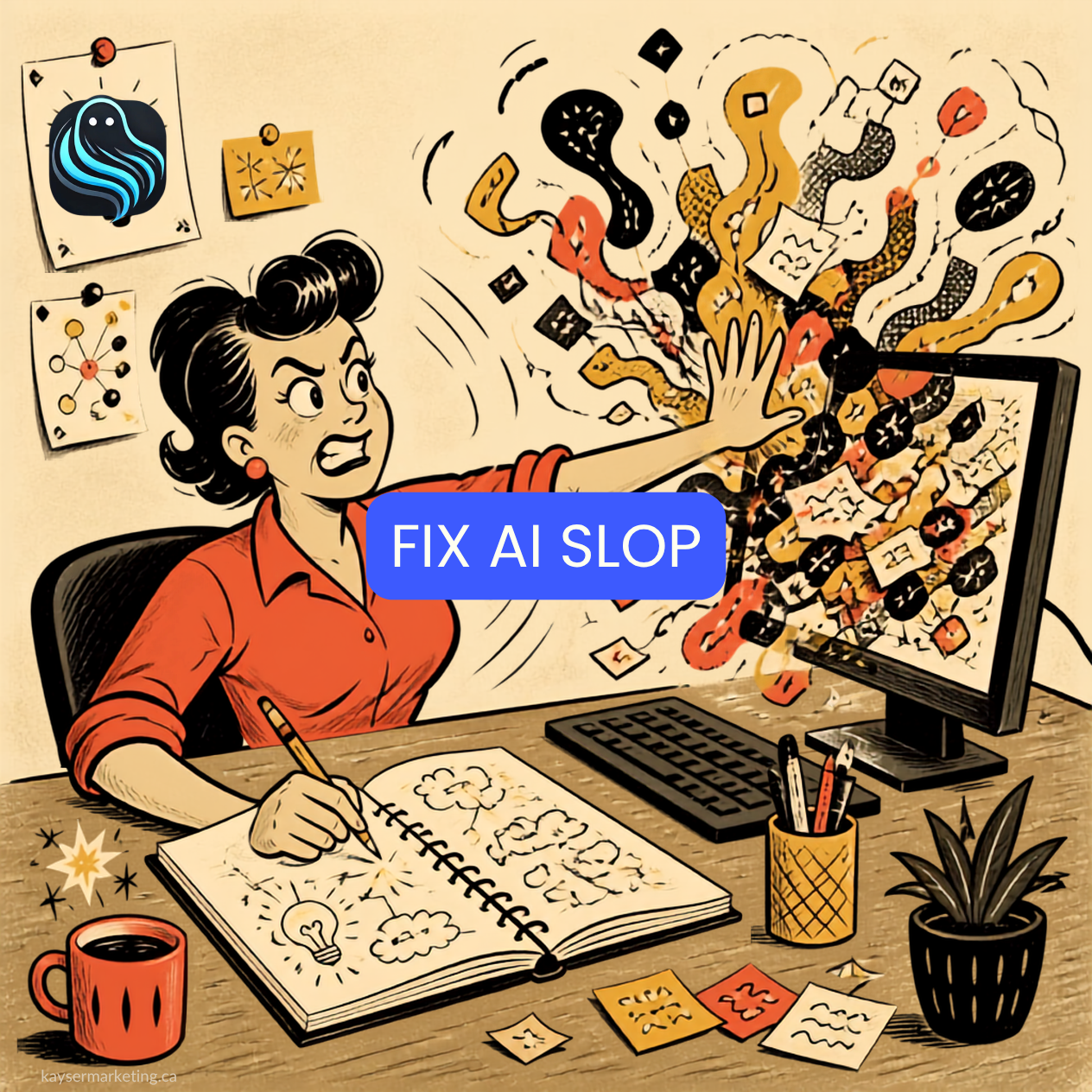
AI slop is a problem when it eliminates all thinking and effort that goes into producing a thing, whether it’s copy, artwork, or code. Sloppy work and shortcuts don’t create raving fans, and it doesn’t have to be generated by AI to be seen as such. I’ve mentored students who produce far worse work than AI does and don’t always thoroughly review and edit my own work when I’m tired or uninspired.
But I fail to see what a pizza maker’s ability to draw or design a logo has to do with making great pizza.
Maybe this Reddit poster is an artist and is salty about AI-generated artwork. I could see that personal vendetta being a valid motive. But given that this is a common stance, I am doubtful that everyone who refuses to do business with a company they assume is using AI is an artist or creative feeling threatened by robots taking their jobs.
And maybe you don’t want to serve a customer who is that sensitive about AI content they see as slop, but I digress.
Business owners are risk-takers, innovators, and renegades who live and die by their own sword. With that responsibility comes a never-ending task list, which most people with enough time on their hands to be ranting on Reddit seem to consider. Using AI to help with the necessary, but not sufficient, production it takes to manage a business is perfectly acceptable and sensible. However, we probably don’t want to risk being boycotted for being seen as cheap or lazy.
So here are a few practical ways to use AI that won’t get you blacklisted by your customers or local community.
Be Cautious of Sycophancy
AI is a terrible yes-man. I think most LLMs must see Robert Greene’s 48 Laws of Power as canon. The model never wants to outshine the master.
Unless you explicitly prompt the LLM to challenge you, you’re going to be right 99% of the time. Even when you’re blatantly wrong. AI becomes much more powerful and personal when you have it support the production of work you are already genuinely skilled in or knowledgeable about.
Otherwise, you might be the fool secretly being outshone by the apprentice.
Don’t Take The First Version Of Anything
Iterate and try multiple models or prompts when you’re generating content and working with AI.
It can be dazzling to have a prompt generate something from nothing for you, but that’s where AI slop typically comes from. At first glance, it might be better than what you’re capable of doing on your own or what the intern who falls asleep at his desk can do for you.
AI will make you sound good. It might even be pretty impressive. But the more that you iterate, the less slop-like it becomes.
Test different angles. Ask it to generate 3 versions. Have it grade each version and run a tournament to form together the winning one. The options are endless, so don’t settle on option number one.
Feed Your Brand To the LLM
Add your brand voice, palette, and other assets that help to refine the content and creative to be better aligned with your brand. You’ll instantly have a more bespoke content generator than the default AI voice that comes without these guidelines.
Most AI tools allow you to create a project or build a skill that will refer to the package of details, like the colours your business uses, what fonts it uses, phrases and slogans, and what should or shouldn’t be talked about. If you don’t already have a Brand Book, you can ask AI to build one for you and then refer to it for future business tasks.
Before having AI do any real amount of work for your business, make sure you’ve set up one of these projects or built the skill in Claude that tells it how to represent your brand. You’ll get far better results and be less frustrated with the quality or being seen as disingenuous by potential customers.
Polish Off With Top Models
If you draft content with a lower-cost model, after you’ve edited and are ready to polish the work before a final review, have a top-tier model review it.
Most LLMs have different tiers with the higher quality output costing more in tokens and draining your usage faster. Drafting with the standard models saves on token costs and then switching to review with the higher model ensures that you’re getting better results, especially when you are cross-referencing your brand, as you should be (see Feed Your Brand above).
Depending on how much you actually use AI, you might be good with just using the higher quality to do everything. When Claude Cowork and Opus 4 and then 5 initially came out, I was running out of token usage multiple times a day, but they’ve increased the usage to the point that I rarely am concerned about running out in the middle of a task or the middle of the workday anymore.
Let AI Be Your Middleman
Spend some time coming up with your own ideas before turning to AI.
If you aren’t good at writing, this is where a lot of people like to use voice dictation to get words on a page. Type them or speak them out loud. However you do it, just get it done. To have AI work in your favour, you want it to start with your own work. You can bounce ideas and brainstorm with the help of the LLM to get new ideas or try different perspectives, but put it into your own words and headings before proceeding.
Also finish the editing yourself. We all have an intuitive itch about content that’s been created by AI, which has been further confirmed with the recently announced watermarking done by Claude for AI-generated writing. Read your final drafts out loud or in your head to see how it sounds.
If a word or phrase sounds a bit off, or doesn’t sound like something you’d say, change it to the way you’d actually say it.
This same rule goes for art and design. A blank page or empty canvas can be daunting but don’t use that as an excuse to not try to think about it before calling up the LLM.
Use It As a Tool, Not a Crutch
Strava is a social platform for sharing your workouts and activities, mostly used by runners and cyclists. One of the attractive features of Strava is competing on segments on the roads and trails in your community to earn PRs and even become the King or Queen of the Mountain for having the fastest ever time. I found out this year there are “Strava Mules” who will compete on these segments on your behalf, for a fee, of course. Why do people hire Strava Mules? For the kudos and false sense of accomplishment that comes from it.
As business owners, we work hard and are anything but lazy. However, only we know just how hard we work. I don’t want to be perceived as being lazy by anyone, especially not my customers and clients. And if you depend on AI to do your thinking for you, it’s a slippery slope to enlisting a mule to embellish your fastest mile time. Outsource the production work but don’t outsource your thinking. Especially as AI becomes a better assistant, you still need to stay sharp mentally.
If you have a Strava Mule hit all your PRs for you, you’ll never become any fitter. If you walk with a crutch all the time, you’ll develop a limp. Don’t let AI become a mental crutch for you.
And keep this list in mind to save your business from AI slop.