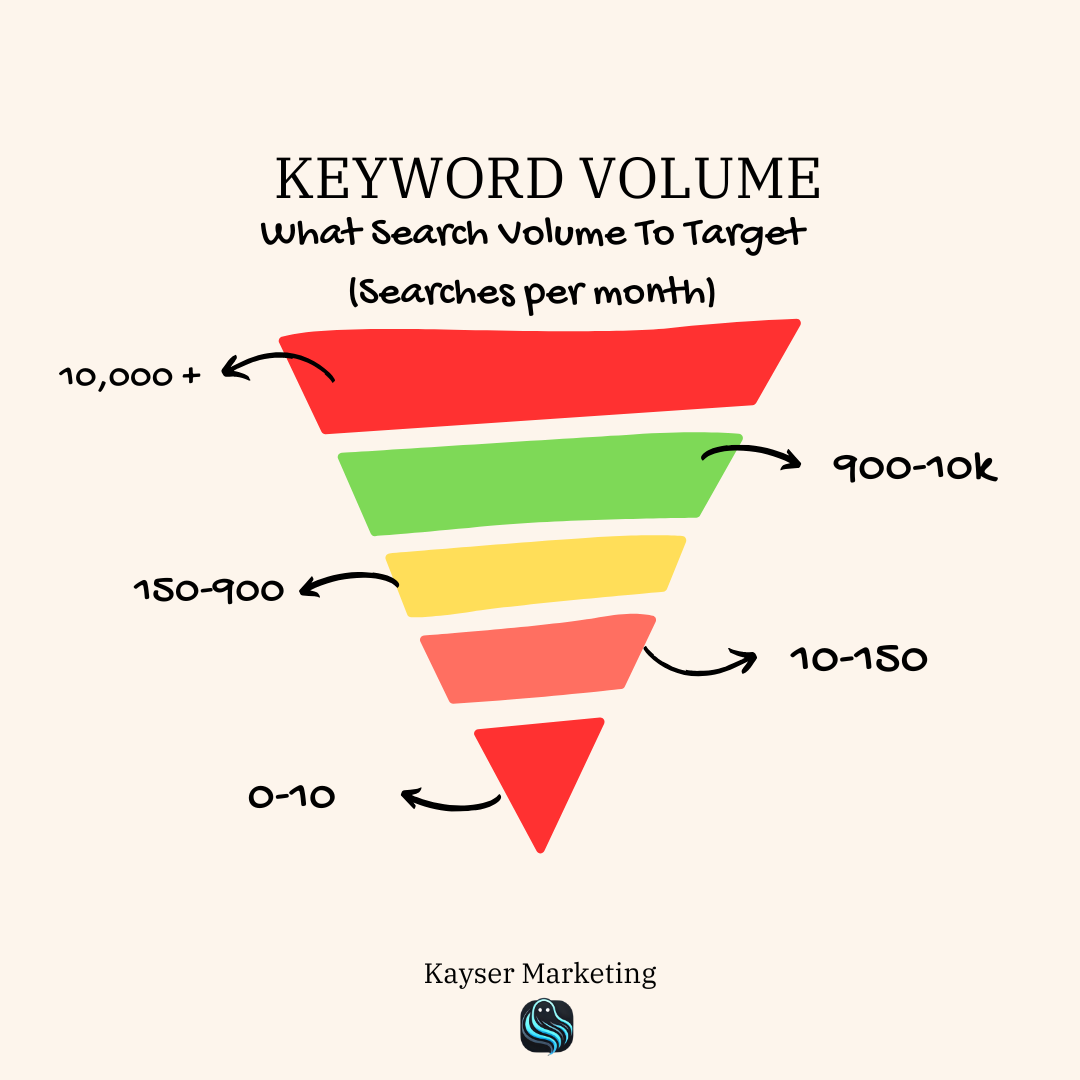
How to judge keywords on search volume
Search volume only means something in context. Here's the simple colour-coded system I use to decide which keywords are worth targeting for a local business.
How to judge keywords on search volume
Keywords take some trial and error before they click. But once the concept lands, it improves almost everything else you do. It’ll help how you write website content that ranks, what you target with ads, and how clearly you talk about what your customers actually want.
When I was learning keyword research, I was stuck on three questions:
- What is a keyword, and why is it called that?
- Which keywords should I use?
- What counts as good search volume, and how would I know?
For a long time, SEO was something I could see working without knowing how or why.
Most people reading about keywords want one of two things: a business website that ranks higher, or ads that reach the right audience. Often both. Keywords sit underneath both, so that's where we'll start.
What is a keyword?
Think of keywords as the magic words that open doors.
If you run a dog walking business called Happy Tails, some people will search "Happy Tails" — but only if you're already well known in your area. Most people type the first generic thing that comes to mind: "dog walker near me," or just "dog walker," and see what shows up on Google.
That phrase is a keyword. It's the language your customer already uses. Your job is to show them you have exactly what they're after by using that same language on your website, or by bidding on it with search ads.
Here's the catch: writing the exact phrase on your website doesn't make you appear in search results. Everyone else is competing for the same phrase, and many of them have been at it for years. What that keyword gives you is a starting point — it’s the topic you build a landing page or a piece of content around, which can climb the results over time.
That's where you go a step further and get more specific.
Think of the Room of Requirement in Harry Potter. Harry only finds the door when he's thinking “I need a place to hide” — the room works by giving you exactly what you need, and it can only do that if you're clear about what that is. Search works the same way. The more precisely someone describes what they're after, the more precisely the results match. And the more precisely your page matches that phrasing, the better your odds of being the door that opens.
A longer, more exact phrase like that is called a long-tail keyword. This is where the concept starts to click, because the right one depends entirely on your area and what people there are searching.
If "dog walker [your city]" is packed with competition, your opportunity might be to target "dog walker for big dogs," or "dog walker [specific neighbourhood]." Or you take on the smaller towns nearby and establish yourself there first.
The keyword that opened a door for me
My first website was a blog about health and fitness. It narrowed toward strongman as I got into the sport.
Strongman equipment was hard to find in 2011 when I started competing, and the more obsessed I got, the more I wanted to train specifically for it. So I started building the equipment myself. In the fall of 2012, my dad and I made a log for overhead presses. I documented the build and published it as How to Make a Strongman Log.
Unbeknownst to me, that phrase had a decent amount of search volume every month. People still search "how to make a strongman log" today, and that traffic still flows into the site.
That first one was luck. What came next was strategy: I improved the post, wrote a part two, and took a second top spot on Google. Then an entire DIY for Strongman series, each post carving out its own steady flow of traffic.
I don't do anything strongman-related anymore. But those posts still rank, and the principles I learned building them are the ones I use on my own business sites and on client work today. Even after migrating that site to new hosting, the right SEO prep meant I kept the traffic flowing to the new website, because I kept the positions I'd held for years.
What is good search volume?
That strongman log keyword was the start of a strategy I repeated across other long-tail keywords: making other equipment, natural strongman training, and so on. It snowballed.
But I was still guessing. I had no idea how to read keyword data.
It took watching a friend's YouTube channel explode in views and subscribers, and hearing her say over and over that keywords were the reason, before I sat down and learned to actually look at the numbers.
Where to get keyword data for free
- VidIQ on YouTube. YouTube is a Google product, so its search bar is a fast way to see what people search across the internet. Type in a word or two and watch what autocompletes. VidIQ gives you some additional keyword data for free and is a simple Chrome plugin to set up.
- Google Ads Keyword Planner. It lives inside Google Ads, so you need an ad account first, which you can create for free without running a single ad. I like it because you can narrow volume to your city or region, so you see the demand that actually exists in your market.
- AnswerThePublic. A few free searches a day, and a good visual of related keywords you can cluster together (more on that below).
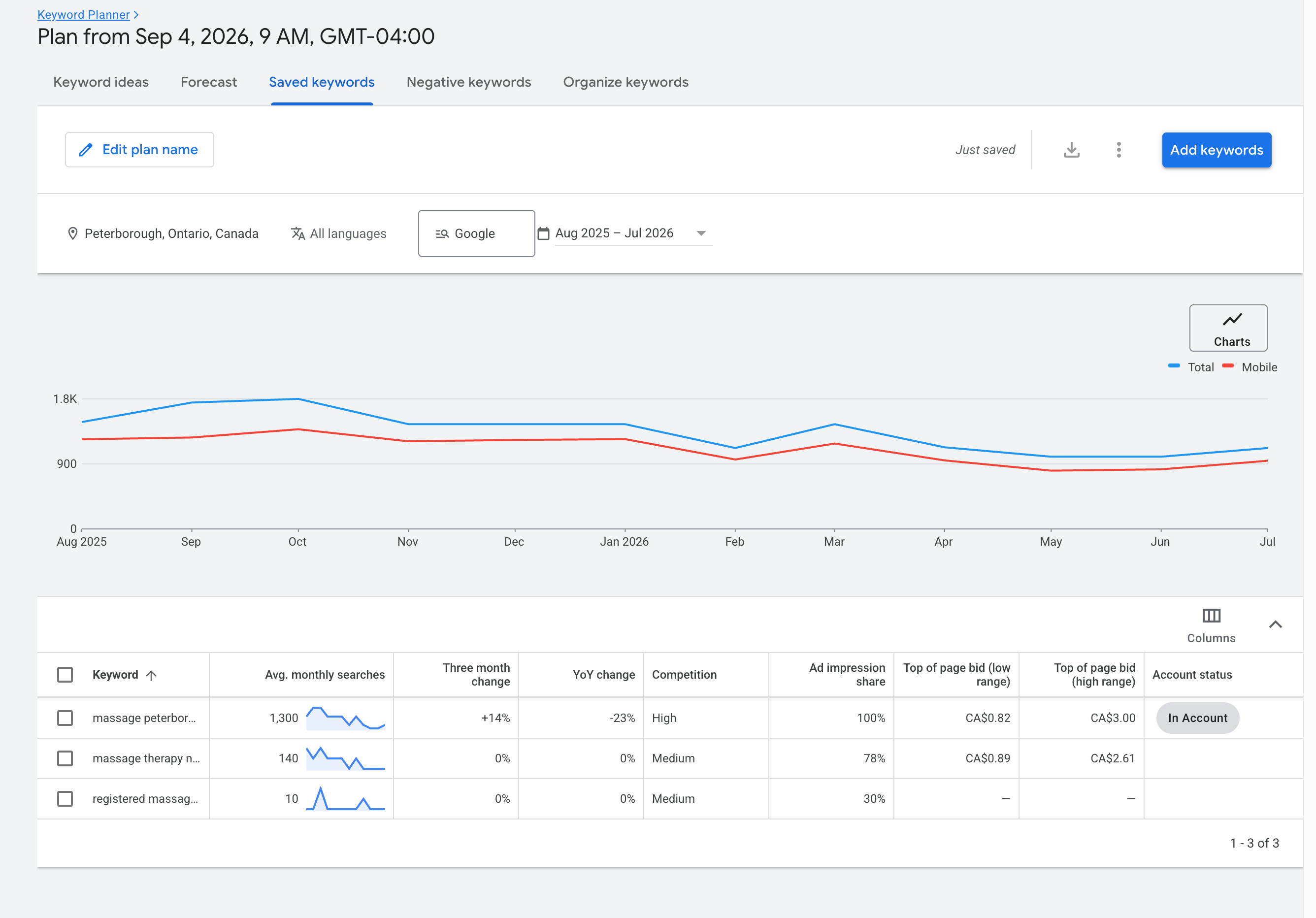
Using a tool like Google Keyword Planner, this shows me the trends around Peterborough specifically for searches like "massage therapy" and "registered massage therapist" to know exactly what people are typing in to search.
If you're serious about SEO, paid data pays for itself. The Bronze plan on Keywords Everywhere, or SEMDash, will get you far enough to develop a feel for the numbers as you play around. Building the mental model of what keywords are good or bad is the real goal of using these tools to understand keyword data.
The colour code I use with clients
Raw numbers don't mean much on their own, and they're easy to misread if you haven't compared a lot of keywords in the same niche. So when I present an SEO strategy, I colour code the data instead. It shows the path forward at a glance.
It shifts by niche and by what I see when I dig into the data, but roughly:
| Colour | Monthly search volume | What it means |
|---|---|---|
| Red | 0, or over 10,000 | Avoid — no demand, or too competitive |
| Orange | Under 150 | Thin on its own, strong in a cluster |
| Yellow | 150–900 | Realistic targets for most local businesses |
| Green | 900–10,000 | The sweet spot, if you can compete |
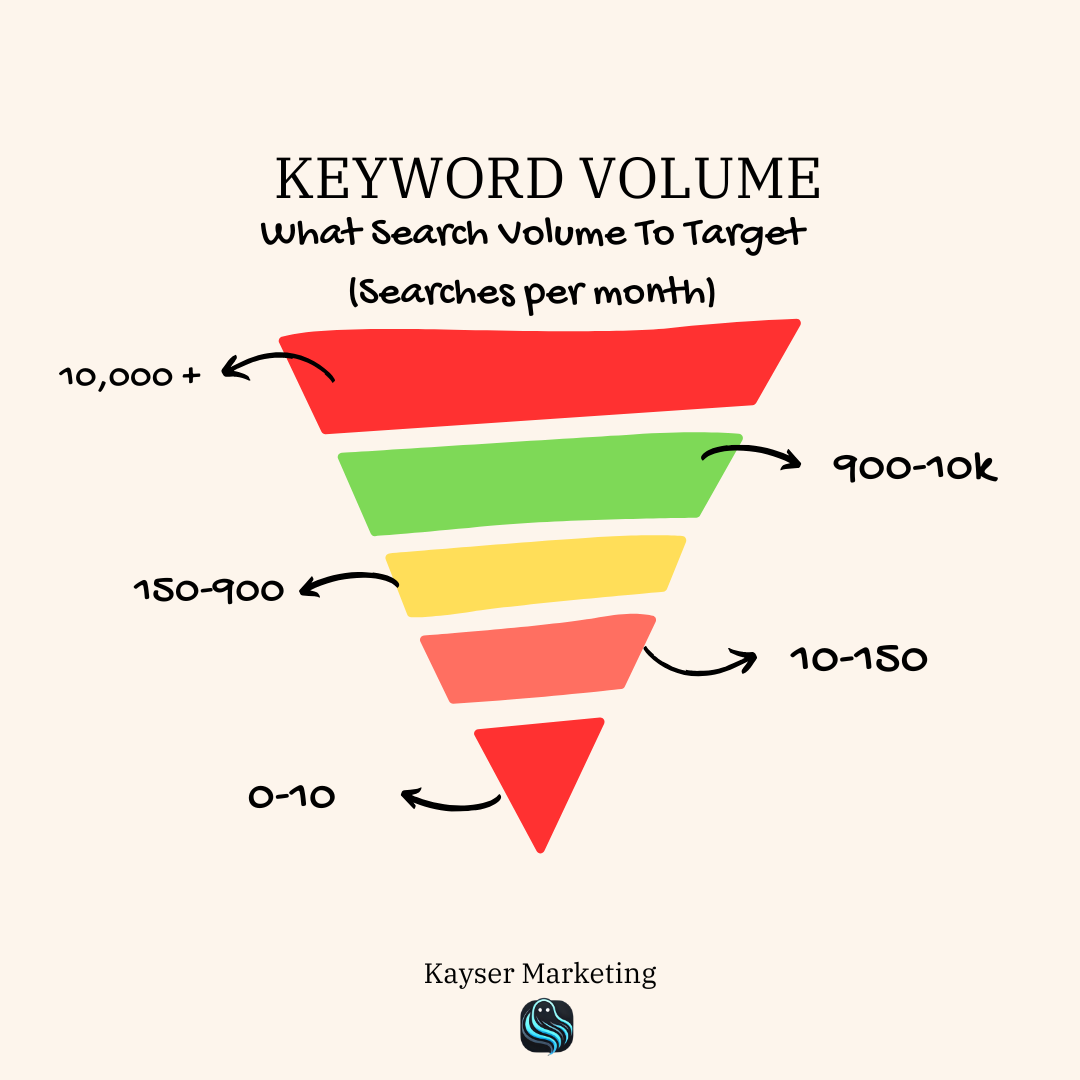
Why not chase the biggest number? Unless your site is already well established, ranking for anything above 10,000 searches a month is a long shot. The competition has already gone after this area and the difficulty is high enough that a new site has little chance.
Treat these as rough guides, not rules. A local design agency might see fewer than 100 searches a month for its core keywords, but the competition is just as low, and the intent behind those searches is very high. Rank there and you can get real leads from a few dozen searches a month.
One more thing: this applies mostly to organic search. The same volume logic holds for paid search, but you don't have to avoid the red band. A low-end red keyword probably won't get you much, but it won't cost you much either. A high-end red keyword already has a crowd bidding on it, so expect to pay a high cost per click if you go after it.
Cluster your keywords
A group of orange keywords can be worth as much as a single yellow or green one.
There's real volume hidden in clusters, once you combine the related long-tails. Look for the patterns that emerge - the phrases that circle the same idea from different angles.
Most keyword tools will cluster similar keywords for you. That grouping tells you what belongs on one page or in one piece of content, and which keywords belong in the same ad group for search ads.
Go forth and practice
I didn't fully understand keywords, or how to build a strategy from them, until I started playing with the tools and watching what my choices produced.
So that's the homework. Open one of the free tools, like AnswerThePublic or the Keyword Planner in Google Ads, and search your own business the way a customer would. If you want the full picture, with a complete keyword strategy and progress tracking, SEMDash is an affordable alternative to the big names like Semrush and Ahrefs. With it, you'll get all the same features as Semrush but what it costs monthly is more than a full year of SEMDash. And, using my code RJ20earlybird gets you an extra 20% off your plan forever. Learn more about SEMDash here.
Start with the words your customers already use. Everything else builds from there.
Want someone to do the digging for you?
Keyword research is simple in principle and slow in practice. If you'd rather skip the trial and error, book a free strategy call and we'll spend it on your keywords.
Come with your website and the area you serve. You'll leave with the search volume in your market, colour-coded the same way you saw above, the long-tail clusters worth building pages around, and a short list of what to target first, so you can use it for organic search, for ads, or both.