How to rank in the Google map pack in Peterborough (the free stuff that beats ads)
The three map results above the fold send more calls than most ad budgets. Here's what actually moves them, what changed in 2026, and what to skip.
How to rank in the Google map pack in Peterborough (the free stuff that beats ads)
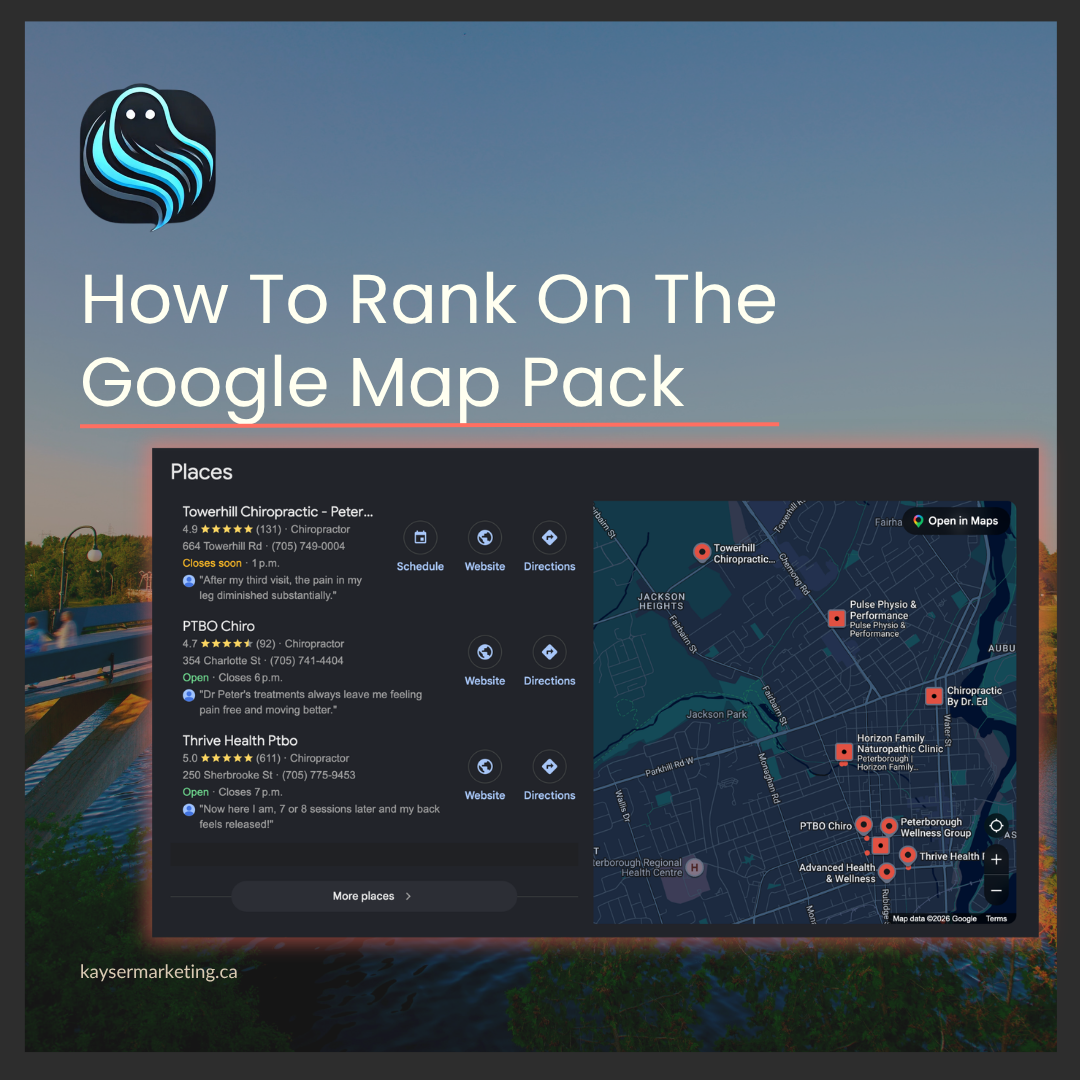
Someone in Peterborough pulls out their phone and types "physiotherapy near me."
Before they see a single website, they see a map and three businesses. That block of top three businesses is the map pack, and on a phone it can fill most of the first screen. A lot of people never scroll past it.
You don't pay for those three spots. You earn them. And most local businesses are leaving them on the table because they set up their Google Business Profile once in 2019 and never touched it again.
Here's what actually moves the needle, in the order I'd do it.
First, the uncomfortable part
Google decides the map pack on three things: relevance, distance, and prominence.
Distance is the big one. In the 2026 Whitespark survey of local search professionals, proximity to the searcher accounts for roughly half of the ranking decision, and you cannot change it. A shop on Chemong Road will struggle to show up for someone searching from Lakefield. That's not a failure of your SEO. Google prioritizes delivering the best results on search, and that depends on the user getting the most relevant results.
This matters because it sets the honest goal. You are not going to own the map pack across the entire Kawarthas from one address. What you can do is own the searches happening near you, and beat the businesses in your immediate radius who haven't bothered.
That's still a lot of phone calls.
If you want to own a wider range than that, that’s where Google Ads come into play.
The levers that actually matter
Of the signals you can control, Google Business Profile factors carry about a third of the total weight — more than your website, more than your backlinks. Reviews are next. Everything else is a distant third.
So here's the order:
1. Your primary category
This is the single highest-impact thing you control, and it takes ninety seconds to fix.
Your primary category tells Google what you are. Get it wrong and nothing else you do compensates. A clinic listed as "Medical Center" instead of "Chiropractor" is competing in the wrong race.
Pick the most specific category that describes your core service. Not the broadest one. Not the one that covers everything you could do. The one that matches what people are searching for when they need you most.
Then add secondary categories for your other services — but be honest. Stuffing in fifteen categories dilutes the signal and can get your profile flagged.
Quick check: search your main service in an incognito window. Look at who's ranking. Their categories are visible in the profile. If yours doesn't match the pattern, that's your answer.
2. Reviews — but velocity, not volume
Review signals are the second-biggest factor, and this is where most businesses misunderstand the game.
Forty reviews collected steadily over a year beats forty collected in one panicked week. Google reads a steady trickle as a healthy business. It reads a burst as manipulation.
What matters:
- Velocity. New reviews arriving consistently. A handful a month beats a flood twice a year.
- Response rate. Reply to all of them. Yes, the good ones too. It's a ranking signal and it's free.
- Recency. A profile whose newest review is from 2024 looks closed.
One important 2026 change: in April, Google explicitly banned staff review quotas and asking customers to name a specific employee in their review. If you've been running a "mention your therapist by name" incentive, stop. That's now a policy violation, and the enforcement is real.
The version that still works is boring and effective: ask at the moment of maximum satisfaction, make it one tap, and don't script it.
3. Your hours — genuinely
Being open at the moment someone searches is now the fifth-strongest factor in the local pack. Fifth. Ahead of things agencies charge four figures a month to work on.
Which means:
- Your regular hours need to be right.
- Your holiday hours need to be set before the holiday. Every stat holiday you don't update, you're either invisible or you're annoying someone who drove out to a locked door.
- If you take appointments outside your posted hours, post those hours.
This is a fifteen-minute job that most businesses get wrong four times a year.
4. Activity — photos, posts, and not going dark
Profiles that go 30+ days without new photos or updates tend to lose visibility. Google is checking whether you're still a going concern.
You don't need a content calendar. You need a phone and a habit:
- Two or three real photos a month. Your actual space, your actual work, your actual team. Not stock.
- The occasional post — a seasonal offer, a new service, a schedule change.
Real photos from the business owner outperform polished stock imagery here, partly because Google's newer AI features pull directly from your profile photos, reviews, and website when generating answers about your business. Give it real material to work with.
5. NAP consistency
Name, address, phone. Identical everywhere — your profile, your website, your Yellow Pages listing, the directory you forgot you signed up for in 2016.
"Unit 4" on one and "#4" on another is enough to muddy the signal. This is tedious and unglamorous and it works.
Start with the big ones: your own website footer, Facebook, Apple Maps, Bing Places, and any industry directory you're listed in.
6. Your website's location pages
On-page signals are about a fifth of the weight. Your map pack ranking is not purely a profile game — Google cross-references what your website says about where you are and what you do.
If your site never mentions Peterborough outside the footer address, that's a gap. Not keyword stuffing — just genuinely writing about the place you operate and the people you serve. I go deeper on this in what local businesses actually need from SEO in 2026.
What changed in 2026 (so you're not chasing ghosts)
A few features you may remember are gone:
- Q&A is dead. Google began phasing it out at the end of 2025. New profiles don't get it, existing content is frozen and disappearing. Don't spend time on it.
- Chat is gone. Google shut down GBP messaging entirely as of July 31. If chat was a lead source for you, you need another route.
- WhatsApp is in. You can now add a WhatsApp contact to your profile. Worth testing if your customers already message that way.
- Video verification is now the default for new listings in most regions. One continuous take showing signage, interior, and you doing something managerial. Have it planned before you start recording — a failed verification can stall a new listing for weeks.
What to skip
- Buying reviews. Detection has gotten good and the penalty is worse than the problem.
- Keyword-stuffing your business name. "Smith Plumbing Peterborough Emergency 24/7" is a policy violation and a competitor can report it in two clicks.
- Citation-building packages. Citations are about 7% of the weight. A $400/month service blasting your NAP to 300 directories is solving your smallest problem.
- Paying for map pack "guarantees." Nobody controls proximity. Anyone promising a specific position is either lying or planning to move your pin, which will get your listing suspended.
The 90-minute version
If you do nothing else this month, do this in one sitting:
- Fix your primary category. Most specific match to your core service.
- Fill every field. Services, service areas, attributes, business description, opening date. Completeness is a signal.
- Audit your hours, and set holiday hours for the next six months right now.
- Upload ten real photos.
- Reply to every review you haven't replied to. All of them.
- Set a review habit — one specific moment in your process where you ask.
- Check your NAP on your website, Facebook, and Apple Maps.
That's it. No budget, no agency, no tools. It compounds for years.
Where this fits with everything else
The map pack is the highest-leverage free thing available to a local business. It's also slow — you're building signals, and signals take months to settle.
Which is why I usually tell people to run both tracks: fix the profile because it's free and permanent, and run ads if you need customers this quarter. I broke down that trade-off in Google Ads vs SEO: which should you spend on first.
And a warning worth repeating: getting found is only half the job. If your map pack listing sends people to a site that doesn't make booking obvious, you've bought yourself better traffic and the same revenue. That's a separate problem, and I've written about the six fixes I make first.
Want a second set of eyes on your profile? I'll audit your Google Business Profile against everything above and send you the specific gaps — free, no pitch. Book a call here.